This is not really a roast. Actually, it's not a roast at all, but it's another pork recipe that can be adopted to be a roast recipe. I made it with bone-in pork chops, and it literally took me 10 minutes to have dinner on the table. It was so good that 10 min later, it was gone.
1. Cut a hole in the pork chop. This is to stuff some goods inside in the subsequent steps.
2. Mix applesauce and dried hot peppers, adding the peppers to your liking.
3. Stuff the pork chop with applesauce/pepper mixture.
4. Mix dried thyme, rosemary, and salt with mustard. I go heavy on the herbs (2 tsp per 1 tbs mustard) since mine are not very potent. I think I had about 1/2 tsp of salt.
5. Slather mustard mixture on one side of the pork.
6. Heat a skillet. When hot, put the pork in, mustard-side up. Turn down heat to med-high and cook 5 min or so. I cover my skillet here to speed up the cooking process.
7. Turn up heat back up to high and flip pork. Cook 3 more min or so.
8. Flip pork over again, add 1/2 cup of sake, close lid, turn down heat to medium and cook 5 min or so, until sake has evaporated.
9. Check that the pork has reached internal temperature of 160F or so and remove from skillet.
10. Add 2 tbs of ketchup and 1/4 cup of sake to the skillet, scrape any goodies off from the pan and blend into ketchup sauce. Serve pork with sauce.
I microwaved pre-cut broccoli and baby carrots while the pork was cooking. Since I hardly eat starches, I don't bother with rice, bread, etc, but the Papa Bear supplemented dinner with white rice.
The applesauce kept the pork very tender and the sauce complimented the sweet and spicy pork so incredibly well. I feel a tad awkward complimenting my own recipe, but this was a true winner. And the speed of it all? That's the best part!
Showing posts with label Sauces. Show all posts
Showing posts with label Sauces. Show all posts
Thursday, January 31, 2008


Thursday, January 24, 2008
Pork Roast: Mustard Version
I love the pork tenderloins they sell at Trader Joe's. The ones that are tubular in shape? They make great roasts that take about two seconds to prep and are great for a busy weeknight dinner. I dress the pork, throw it in the oven, go do something else for 15 min or so, come back to whip up a salad, microwave some more veggies, and voila! Dinner is served!
I have several different versions of the pork roast, but this one is what we are having for dinner tonight:
0. Turn oven on to 400F.
1. Cut pork tenderloin in the middle without slicing into two discrete pieces (just enough of a cut to allow goodies to be put in the middle).
2. Slather apricot jam/orange maramalade/or anything else like that in the middle.
3. Fold the pork closed and place in a roasting pan or Pyrex dish.
4. Mix:
1/4 cup mustard
1/4 cup bread crumbs
1.5 tbs toasted sesame seeds
1 tbs dried oregano
1 tsp salt
1 tsp pepper
5. Slather mustard mixture on top of the pork.
6. Bake, 400F, 25-30 min or until center portion reaches at least 160F.
I have several different versions of the pork roast, but this one is what we are having for dinner tonight:
0. Turn oven on to 400F.
1. Cut pork tenderloin in the middle without slicing into two discrete pieces (just enough of a cut to allow goodies to be put in the middle).
2. Slather apricot jam/orange maramalade/or anything else like that in the middle.
3. Fold the pork closed and place in a roasting pan or Pyrex dish.
4. Mix:
1/4 cup mustard
1/4 cup bread crumbs
1.5 tbs toasted sesame seeds
1 tbs dried oregano
1 tsp salt
1 tsp pepper
5. Slather mustard mixture on top of the pork.
6. Bake, 400F, 25-30 min or until center portion reaches at least 160F.
Monday, January 21, 2008
Wa-saucy!
OK, OK, so the title was a really bad play on words...
I am a big fan of making sauces of all sorts. It is actually what I love the most about cooking - mixing different ingredients to see what comes out at the end. I match different textures, flavors, and scents, while imagining what the sauce will do to the saucee - the saucee being the object of affection with which the sauce will be consumed. It is truly one of my favorite things to do in the kitchen.
It is a misconception that sauces need to be high in fat to be creamy. I used to buy into the mayonnaise-as-base fundamentals of making creamy sauces. I recently learned that Fat-Free European-style yogurt works better than mayonnaise with 1/3 of the calorie. I basically substitute yogurt for all my mayo-based sauces and dips now.
Here's one my stand-bys. This is great with steamed vegetables or other crudites.
1 tbs wasabi from a tube
1 tsp soba/udon sauce (I have this as a home-made sauce, frozen; however this can be bought in bottles at most grocery stores these days.)
3 tbs yogurt (I go fat-free, and it's plenty creamy)
Mix well.
And that's it! This is great as a dipping sauce, but it can also be used as salad dressing. As salad dressing, though, the wasabi might be ultra-potent, so I'd go a bit easy on the wasabi. This is also great with grilled scallops; it can even work with grilled chicken if you add a touch more salt to it.
It's so easy, I almost feel silly writing it. But I am hoping that this blog can help The Papa Bear gain independence in the kitchen, which means I must write down even the most simplest of recipes...
I am a big fan of making sauces of all sorts. It is actually what I love the most about cooking - mixing different ingredients to see what comes out at the end. I match different textures, flavors, and scents, while imagining what the sauce will do to the saucee - the saucee being the object of affection with which the sauce will be consumed. It is truly one of my favorite things to do in the kitchen.
It is a misconception that sauces need to be high in fat to be creamy. I used to buy into the mayonnaise-as-base fundamentals of making creamy sauces. I recently learned that Fat-Free European-style yogurt works better than mayonnaise with 1/3 of the calorie. I basically substitute yogurt for all my mayo-based sauces and dips now.
Here's one my stand-bys. This is great with steamed vegetables or other crudites.
1 tbs wasabi from a tube
1 tsp soba/udon sauce (I have this as a home-made sauce, frozen; however this can be bought in bottles at most grocery stores these days.)
3 tbs yogurt (I go fat-free, and it's plenty creamy)
Mix well.
And that's it! This is great as a dipping sauce, but it can also be used as salad dressing. As salad dressing, though, the wasabi might be ultra-potent, so I'd go a bit easy on the wasabi. This is also great with grilled scallops; it can even work with grilled chicken if you add a touch more salt to it.
It's so easy, I almost feel silly writing it. But I am hoping that this blog can help The Papa Bear gain independence in the kitchen, which means I must write down even the most simplest of recipes...
Sunday, October 09, 2005
Paper Chef: Vietnamese Autumn Rolls
I'm finally getting my life back in order after an insane month that left me longing to be a housewife somewhere other than Japan (or at least trying to), and to kick off my rebirth, I had a few friends over for dinner tonight to try a creative twist of an old favorite - Vietnamese Summer Rolls.
As I've written before, these fresh, salad-based wraps are sometimes known as Spring rolls, Summer rolls, or Fresh rolls. One thing they are never known as are Autumn rolls. So, when Stephen of Stephen Cooks suggested that we all make an Autumn-themed dish with duck, pears, nut butter, and ginger for the most recent Paper Chef event, it was only natural for me to try to make Vietnamese Autumn rolls. I used the Paper Chef excuse to cook up something I wouldn't do normally - like roasting a whole duck.
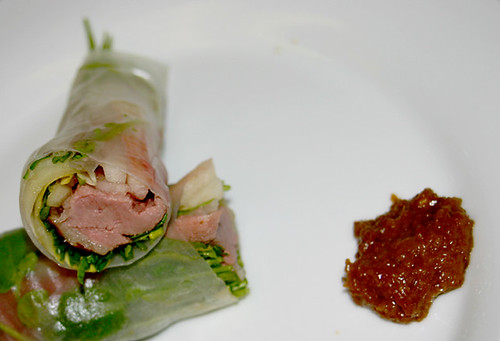
My Paper Chef entry is my take of the Vietnamese rolls as a Autumn version with duck as the meat with pears, endives and watercress as the 'herbs'. My dipping sauce was a soy nut butter-ginger-pear-duck broth dipping sauce instead of the simple peanut sauce.
One thing I'm not that good at doing is knowing what vegetables and what fruits are best at which season. Of course I know strawberries are good in the Spring, tomatoes in the Summer, and hard and/or root vegetables in the Fall, but this seasonality thing is something I am still learning. In my defense, I know all about the seasonality of Japanese fruits, but many of those aren't available here!
Anyway, a quick Google search told me that endives and watercress were in peak season in Autumn, so I went with endives and watercress as my 'Autumn herbs'. But living in the Bay Area, where tomatoes are still ruling the Farmer's Market stalls, I didn't see any of either. I found them in Whole Foods, but that means nothing in terms of seasonality. I hope they qualify as Autumn herbs!
After running around for the whole morning, I started in the kitchen by getting my duck marinade together:
2 cups sake
2 cups soy sauce
1 cup orange juice (squeezed from real oranges - I have them frozen from orange season)
1/4 cup hoisin sauce
1/4 cup plum sauce (found in Asian grocery stores - kind of like a lemonish/plum jelly)
1/8 cup pomegranate molasses
3 lobes grated ginger
Although measurements are approximate, I whisked all of these things together and made sure it was savory-sweet. I then washed and wiped my whole duck and let it soak in the marinade bath for maybe an hour.
In the mean time, I made the sauce:
I washed and boiled the neck and gizzards from the duck, taking away all that yucky stuff that float up - this duck broth was going to be the basis of my dipping sauce today. The combination of the dipping sauce and the salad roll is really what defines these Vietnamese rolls, and I thought that the sauce being made with the same duck 'essence' was the best way to make sure the rolls have the best accompaniment.
While the duck broth was in progress, I grated a humongous multi-lobed ginger (maybe five lobes?) and a peeled pear for the dipping sauce. I didn't know a pear could be so easily grated, but grating the pear released all of the juices very nicely while giving the sauce that necessary consistency. When the duck broth stopped producing all the yucky stuff, I let it simmer for a while (maybe 30 min? I lost track of time crocheting my turtle, inspired by Super Eggplant's Florence. Yes, you will see my turtle when he is fully born...).
I added the ginger and the pear into the duck broth when I could peel myself away from my crocheting project and let it simmer some more. I added some hoisin sauce and soy butter (my nut butter choice) into the duck broth and whisked it together. I probably added about 1/4 cup each, but this is totally a personal choice - please put in as much or as little of either ingredient to make a duck-powered soy nut sauce. This is very, very similar to the peanut sauces that frequently come with Summer rolls in restaurants, except a little thicker (because of the pear and ginger both) and spicier (because of the ginger).
With the sauce finished, I went to roast the duck:
I stuffed the inside of the duck with a pear and an apple (the apple was a generous freebie from the pear vendor at the Farmer's Market today!). I roasted the duck in my oven (which has really no accurate temperature control) with various settings, but I wouldn't trust anything I say about the temperature control. I've come to understand my oven by using my hand as a temperature gauge, so I roasted it until the outside was crispy and the inside moist. It took about another hour or so when it was all said and done.
Assembly of the final product was easy:
I washed the endives and the watercress, and just in time, Anne and the Papa Bear walked in to help me slice and dice the duck after its post-roasting 'resting period'. I peeled and chopped up another pear into thin slivers to wrap inside along with the endives and the watercress.
Final step was wrapping! I wrapped one just to take pictures of it by rolling the endives, watercress, pear slivers, and duck into the rice paper. I sliced the roll in half just for the photo shot and dabbed some soy nut butter-ginger-pear-duck broth dipping sauce on the side.
For the actual dinner, Shan joined the three of us for a wrap-it-yourself feast of Autumn rolls:
And I've got to say - this was a good combination! A success! The spiciness of the watercress inside the roll and the ginger in the dipping sauce complimented the duck very well. The sweetness from the pears, the duck itself, and the dipping sauce gave the spiciness a nicely balanced contrast. The crunchiness of the pears and the endives made the overall effect of the rolls quite refreshing despite the richness from the duck.
I also made a pumpkin-shiitake mushroom couscous (material for another post) to go with the Harvest theme and served the whole meal with a Pumpkin Ale for those of us who imbibe (two out of four).
It was a nice evening with a breeze of Autumn on a Sunday night. Thanks for a wonderful opportunity to get creative, Stephen!
PS: The Papa Bear says, "What the heck is Vietnamese about this dish?!". Ha.
As I've written before, these fresh, salad-based wraps are sometimes known as Spring rolls, Summer rolls, or Fresh rolls. One thing they are never known as are Autumn rolls. So, when Stephen of Stephen Cooks suggested that we all make an Autumn-themed dish with duck, pears, nut butter, and ginger for the most recent Paper Chef event, it was only natural for me to try to make Vietnamese Autumn rolls. I used the Paper Chef excuse to cook up something I wouldn't do normally - like roasting a whole duck.
My Paper Chef entry is my take of the Vietnamese rolls as a Autumn version with duck as the meat with pears, endives and watercress as the 'herbs'. My dipping sauce was a soy nut butter-ginger-pear-duck broth dipping sauce instead of the simple peanut sauce.
One thing I'm not that good at doing is knowing what vegetables and what fruits are best at which season. Of course I know strawberries are good in the Spring, tomatoes in the Summer, and hard and/or root vegetables in the Fall, but this seasonality thing is something I am still learning. In my defense, I know all about the seasonality of Japanese fruits, but many of those aren't available here!
Anyway, a quick Google search told me that endives and watercress were in peak season in Autumn, so I went with endives and watercress as my 'Autumn herbs'. But living in the Bay Area, where tomatoes are still ruling the Farmer's Market stalls, I didn't see any of either. I found them in Whole Foods, but that means nothing in terms of seasonality. I hope they qualify as Autumn herbs!
After running around for the whole morning, I started in the kitchen by getting my duck marinade together:
2 cups sake
2 cups soy sauce
1 cup orange juice (squeezed from real oranges - I have them frozen from orange season)
1/4 cup hoisin sauce
1/4 cup plum sauce (found in Asian grocery stores - kind of like a lemonish/plum jelly)
1/8 cup pomegranate molasses
3 lobes grated ginger
Although measurements are approximate, I whisked all of these things together and made sure it was savory-sweet. I then washed and wiped my whole duck and let it soak in the marinade bath for maybe an hour.
In the mean time, I made the sauce:
I washed and boiled the neck and gizzards from the duck, taking away all that yucky stuff that float up - this duck broth was going to be the basis of my dipping sauce today. The combination of the dipping sauce and the salad roll is really what defines these Vietnamese rolls, and I thought that the sauce being made with the same duck 'essence' was the best way to make sure the rolls have the best accompaniment.
While the duck broth was in progress, I grated a humongous multi-lobed ginger (maybe five lobes?) and a peeled pear for the dipping sauce. I didn't know a pear could be so easily grated, but grating the pear released all of the juices very nicely while giving the sauce that necessary consistency. When the duck broth stopped producing all the yucky stuff, I let it simmer for a while (maybe 30 min? I lost track of time crocheting my turtle, inspired by Super Eggplant's Florence. Yes, you will see my turtle when he is fully born...).
I added the ginger and the pear into the duck broth when I could peel myself away from my crocheting project and let it simmer some more. I added some hoisin sauce and soy butter (my nut butter choice) into the duck broth and whisked it together. I probably added about 1/4 cup each, but this is totally a personal choice - please put in as much or as little of either ingredient to make a duck-powered soy nut sauce. This is very, very similar to the peanut sauces that frequently come with Summer rolls in restaurants, except a little thicker (because of the pear and ginger both) and spicier (because of the ginger).
With the sauce finished, I went to roast the duck:
I stuffed the inside of the duck with a pear and an apple (the apple was a generous freebie from the pear vendor at the Farmer's Market today!). I roasted the duck in my oven (which has really no accurate temperature control) with various settings, but I wouldn't trust anything I say about the temperature control. I've come to understand my oven by using my hand as a temperature gauge, so I roasted it until the outside was crispy and the inside moist. It took about another hour or so when it was all said and done.
Assembly of the final product was easy:
I washed the endives and the watercress, and just in time, Anne and the Papa Bear walked in to help me slice and dice the duck after its post-roasting 'resting period'. I peeled and chopped up another pear into thin slivers to wrap inside along with the endives and the watercress.
Final step was wrapping! I wrapped one just to take pictures of it by rolling the endives, watercress, pear slivers, and duck into the rice paper. I sliced the roll in half just for the photo shot and dabbed some soy nut butter-ginger-pear-duck broth dipping sauce on the side.
For the actual dinner, Shan joined the three of us for a wrap-it-yourself feast of Autumn rolls:
And I've got to say - this was a good combination! A success! The spiciness of the watercress inside the roll and the ginger in the dipping sauce complimented the duck very well. The sweetness from the pears, the duck itself, and the dipping sauce gave the spiciness a nicely balanced contrast. The crunchiness of the pears and the endives made the overall effect of the rolls quite refreshing despite the richness from the duck.
I also made a pumpkin-shiitake mushroom couscous (material for another post) to go with the Harvest theme and served the whole meal with a Pumpkin Ale for those of us who imbibe (two out of four).
It was a nice evening with a breeze of Autumn on a Sunday night. Thanks for a wonderful opportunity to get creative, Stephen!
PS: The Papa Bear says, "What the heck is Vietnamese about this dish?!". Ha.
Sunday, August 07, 2005
Paper Chef: Kalbi-Gone-Local
It's been SOOOO long since I actually had the time and mental stability to tackle something in the kitchen, and this month's Paper Chef event had the perfect theme to go along my NoCal LoCal challenge (OK, was that a really lame, dorky title that shouldn't have been repeated?!)! Thanks for going local, Owen!
The challenge was to use (dried) chili peppers, peaches, edible flowers, and another local ingredient to concoct something tasty. I thought and thought and thought about this one, so much that I actually came up with a total of four dishes I could've made. Since it's been 100F+ around where I live, I briefly considered doing something like a hot and sweet peach sauce to go over ice cream. I quickly decided that I just wasn't hungry for anything sweet right now. I then played around with the idea of a peach salsa, but then I remembered that I didn't really like fruity salsa that much... I was just about to start making a turkey-peach meat ball (like chicken-apple sausage) to go inside dumplings, when I came up with a better idea. What better way to combat the heat than having some tasty, local-powered, home-grilled KALBI?!
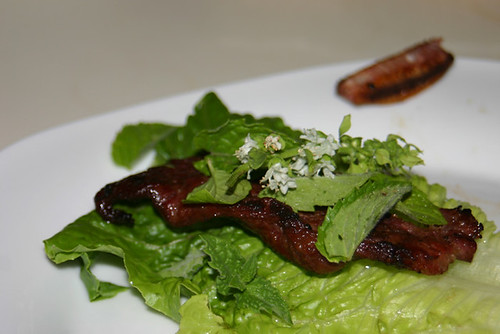
I'm proud to say that all the produce I used tonight came either from the local farmers or from our very own (planter box) garden!!
The following produce were purchased from my favorite organic and/or all-natural (uncertified organic) farms at the Pleasanton Farmer's Market:
- garlic (my chosen local ingredient #1)
- lettuce (my chosen local ingredient #2)
- white peaches
- basil with flowers (ours is recovering from a recent harvest)
From our very own planter boxes came:
- mint (my chosen local ingredient #3)
- chili peppers (ours is so hot, it's made many grown men cry.)
The short ribs came from the meat department at Whole Foods, who serves a wide variety of cuts, all hormone- and antibiotic-free (the only kind of meat I really feel good about eating). Unfortunately, although my soy sauce is organic and my sake is junmai (pure-rice, none of that industrial alcohol in my sake!), both of them were purchased at one of the big Asian grocery stores...
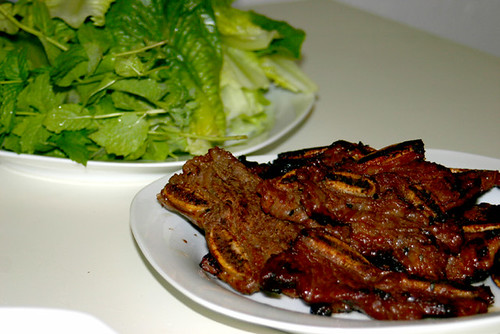
I made the marinade with crushed garlic and peaches, sake, soy sauce, roasted sesame seeds, and our very own chili peppers from our planter boxes (I substituted fresh peppers for dried ones). I saved some of the marinade to use as dipping sauce later, then dumped the meat in the marinade. Periodically, I massaged and kneaded the beef in the marinade to make sure the marinade soaked into the meat well. A couple hours later, on the hot grill they went (thanks, Papa Bear!), and a short while later, voila! My Paper Chef entry was done!
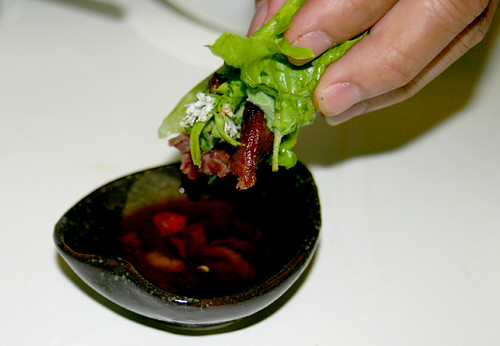
Although I had some kimchee to go with it, for the first bite of my Kalbi-Gone-Local, I wrapped the meat in lettuce along with my home-grown mints (home-grown from seeds for the first time!!!) and the basil flower, the only edible flower that could be found in the Pleasanton Farmer's Market. The marinade had that natural sweetness of juicy peaches with the kick of our extra-hot peppers, and the refreshing herbal notes of the mint and the basil cut the oil of the short ribs. I don't think I would've ever thought to make a Kalbi marinade with white peaches if it weren't for the Paper Chef theme, so this was a very worthwhile and fun culinary adventure for me!
Thanks for the inspiration and the wonderful ingredient list, Owen!
PS:
I'd leave you with a better recipe, except everything was eye balled. Here's a very approximate list for the marinade...
1 cup sake
1/2 ~ 3/4 cup soy sauce (to taste, should be salty-sweet)
3 garlic cloves, crushed
1 large white peach, cored and crushed
3 tbs toasted sesame seeds
Mix, use as dipping sauce or meat marinade. Enjoy!
The challenge was to use (dried) chili peppers, peaches, edible flowers, and another local ingredient to concoct something tasty. I thought and thought and thought about this one, so much that I actually came up with a total of four dishes I could've made. Since it's been 100F+ around where I live, I briefly considered doing something like a hot and sweet peach sauce to go over ice cream. I quickly decided that I just wasn't hungry for anything sweet right now. I then played around with the idea of a peach salsa, but then I remembered that I didn't really like fruity salsa that much... I was just about to start making a turkey-peach meat ball (like chicken-apple sausage) to go inside dumplings, when I came up with a better idea. What better way to combat the heat than having some tasty, local-powered, home-grilled KALBI?!
I'm proud to say that all the produce I used tonight came either from the local farmers or from our very own (planter box) garden!!
The following produce were purchased from my favorite organic and/or all-natural (uncertified organic) farms at the Pleasanton Farmer's Market:
- garlic (my chosen local ingredient #1)
- lettuce (my chosen local ingredient #2)
- white peaches
- basil with flowers (ours is recovering from a recent harvest)
From our very own planter boxes came:
- mint (my chosen local ingredient #3)
- chili peppers (ours is so hot, it's made many grown men cry.)
The short ribs came from the meat department at Whole Foods, who serves a wide variety of cuts, all hormone- and antibiotic-free (the only kind of meat I really feel good about eating). Unfortunately, although my soy sauce is organic and my sake is junmai (pure-rice, none of that industrial alcohol in my sake!), both of them were purchased at one of the big Asian grocery stores...
I made the marinade with crushed garlic and peaches, sake, soy sauce, roasted sesame seeds, and our very own chili peppers from our planter boxes (I substituted fresh peppers for dried ones). I saved some of the marinade to use as dipping sauce later, then dumped the meat in the marinade. Periodically, I massaged and kneaded the beef in the marinade to make sure the marinade soaked into the meat well. A couple hours later, on the hot grill they went (thanks, Papa Bear!), and a short while later, voila! My Paper Chef entry was done!
Although I had some kimchee to go with it, for the first bite of my Kalbi-Gone-Local, I wrapped the meat in lettuce along with my home-grown mints (home-grown from seeds for the first time!!!) and the basil flower, the only edible flower that could be found in the Pleasanton Farmer's Market. The marinade had that natural sweetness of juicy peaches with the kick of our extra-hot peppers, and the refreshing herbal notes of the mint and the basil cut the oil of the short ribs. I don't think I would've ever thought to make a Kalbi marinade with white peaches if it weren't for the Paper Chef theme, so this was a very worthwhile and fun culinary adventure for me!
Thanks for the inspiration and the wonderful ingredient list, Owen!
PS:
I'd leave you with a better recipe, except everything was eye balled. Here's a very approximate list for the marinade...
1 cup sake
1/2 ~ 3/4 cup soy sauce (to taste, should be salty-sweet)
3 garlic cloves, crushed
1 large white peach, cored and crushed
3 tbs toasted sesame seeds
Mix, use as dipping sauce or meat marinade. Enjoy!
Sunday, July 31, 2005
IMBB: TasteTea Ochazuke
This month's Is My Blog Burning theme, hosted by Clement over at A La Cuisine! is TasteTea - any dishes made with tea.
I mulled over this one for several days. I thought about my matcha agar blocks, but that was already a previous IMBB dish. I considered making some other green tea dessert, but I'm not really in a sweet phase right now and didn't find dessert dishes to be too appealing. I played around with the idea of going online and finding a recipe for tea-smoked chicken, but didn't feel like making anything elaborate this weekend...
During my recipe search, I came across a rice salad made by cooking wild rice in tea, and I had a light bulb moment. I'd been eating a tea-less version of a tea dish all my life, and I just hadn't thought of it as a tea dish, even though smack in its Japanese name is the word for tea - OCHAzuke - Japanese tea porridge!
Ochazuke, which literally translates to Tea Soaked, is a rice dish that I've had on a very, very regular basis since I was old enough to boil water. Most of the time, I use left over rice and a 'ochazuke package', which has dried tea/broth (I don't know for sure if it's broth or tea powder...) and the trimmings, consisting of rice crackers and seaweed. There can be some kind of additional flavoring in these in the form of dehydrated wasabi, ume plum, or salmon too. All I have to do is pour the packet over microwaved rice and reconstitute it with boiling hot water. The powder has some tea-colorings, although I have never noticed a tea flavor in it...
The most recent 91st issue (yes, there really is 91 issues, published bi-annually...) of my epicurean bible, Oishinbo, had a whole chapter dedicated to the art of Ochazuke, and if you look really, really closely at this tiny picture on Amazon.co.jp, you'll notice that it is Ochazuke on the cover. I've never made this dish from scratch using real tea, so this will be an adventure, perfect for the IMBB occasion!
I started by making the seaweed (nori) preserve (tsukudani) that goes on top (recipes are at the end). This is also the main seasoning. I crushed some rice crackers from Trader Joe's since something crunchy is absolutely key to this dish, but there is no way I can find those perfectly round Ochazuke rice crackers last minute around here. I knew I was OK with wasabi, since my mother sent me a life time supply of wasabi-in-a-tube a while back. I then had a panic moment when I couldn't find my stash of rice-popped sencha (toasted green tea - perfect bitterness to go with the umami-powered seaweed preserve), needed for the dish. Luckily, Anne had just come back from Boston and brought me some of tea from her favorite tea shop (any guesses? this is going to be a feature of its own, so I won't spill details here), and one of the tea she gave me was sencha. Lucky, lucky.
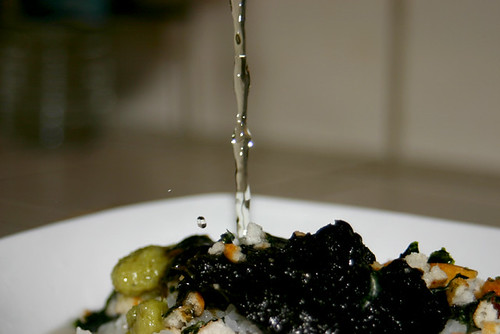
Once the tea was brewed and the rice was cooked, I piled some seaweed preserve, wasabi, and rice crackers, followed by a generous pouring of hot sencha. Done.
I'd share with you some pictures of the finished product, but alas, this dish needs to be consumed as soon as it is finished to be enjoyed properly... There was no time to be wasted for photo ops! This is such a simple dish, but it turned out to be quite satisfying. Most unbelievably, the bitterness of the sencha was totally gone, blanketed by the intense umami sensation of the seaweed preserve and the potent sting of the wasabi. That being said, the bitterness of the tea definitely contributed to the overall effect of the dish as a nice undertone and there is no way this dish can be made with boiling water instead of hot tea.
My seaweed preserve turned out very well, and had I known that I could make it so easily, I would've made it for my grandfather who is no longer with us. Seaweed preserve is sort of like jam here, where it's entirely possible and relatively easy to make at home, but because jarred versions can be so readily purchased, most people just buy it at the store. My grandfather loved this stuff, and always kept various jars in his fridge. Here's one for Ji-chan!!
Recipe:
Seaweed Preserve (nori no tsukudani)
5 sheet nori (seaweed like the one used for sushi)
2 cups sake in 1/2 cup increments
1/2-1 cup soy sauce
1/4 cup mirin (Japanese sweet rice wine)
1/8 cup Toasted sesame seeds
1. Tear up all the nori into approximately 2 inch x 2 inch pieces
2. Pour first 1/2 cup sake into a small pan on high heat
3. Add nori and cook until almost all of the sake is absorbed
4. Repeat until 1 1/2 cups of sake is almost all absorbed
5. Add soy sauce, mirin, and sesame seeds
6. Add last 1/2 cup of sake
7. Cook until all of the liquid is absorbed and the seaweed has a very thick consistency.
8. Keep in an air tight container in the fridge.
Ochazuke:
1. Build the Ochazuke from top to bottom with rice, seaweed preserve, wasabi(or ume plum paste) to taste, and 1 tbs small bits of crackers. More seaweed preserve, wasabi or ume paste can be added later, so I recommend starting with less. For 1/2 cup cooked rice, I'd go with 2 tbs seaweed preserve and 1 tsp wasabi paste, 1/4 tsp ume paste.
2. Pour hot sencha tea, brewed strong.
3. Enjoy right away after mixing with your spoon!
I mulled over this one for several days. I thought about my matcha agar blocks, but that was already a previous IMBB dish. I considered making some other green tea dessert, but I'm not really in a sweet phase right now and didn't find dessert dishes to be too appealing. I played around with the idea of going online and finding a recipe for tea-smoked chicken, but didn't feel like making anything elaborate this weekend...
During my recipe search, I came across a rice salad made by cooking wild rice in tea, and I had a light bulb moment. I'd been eating a tea-less version of a tea dish all my life, and I just hadn't thought of it as a tea dish, even though smack in its Japanese name is the word for tea - OCHAzuke - Japanese tea porridge!
Ochazuke, which literally translates to Tea Soaked, is a rice dish that I've had on a very, very regular basis since I was old enough to boil water. Most of the time, I use left over rice and a 'ochazuke package', which has dried tea/broth (I don't know for sure if it's broth or tea powder...) and the trimmings, consisting of rice crackers and seaweed. There can be some kind of additional flavoring in these in the form of dehydrated wasabi, ume plum, or salmon too. All I have to do is pour the packet over microwaved rice and reconstitute it with boiling hot water. The powder has some tea-colorings, although I have never noticed a tea flavor in it...
The most recent 91st issue (yes, there really is 91 issues, published bi-annually...) of my epicurean bible, Oishinbo, had a whole chapter dedicated to the art of Ochazuke, and if you look really, really closely at this tiny picture on Amazon.co.jp, you'll notice that it is Ochazuke on the cover. I've never made this dish from scratch using real tea, so this will be an adventure, perfect for the IMBB occasion!
I started by making the seaweed (nori) preserve (tsukudani) that goes on top (recipes are at the end). This is also the main seasoning. I crushed some rice crackers from Trader Joe's since something crunchy is absolutely key to this dish, but there is no way I can find those perfectly round Ochazuke rice crackers last minute around here. I knew I was OK with wasabi, since my mother sent me a life time supply of wasabi-in-a-tube a while back. I then had a panic moment when I couldn't find my stash of rice-popped sencha (toasted green tea - perfect bitterness to go with the umami-powered seaweed preserve), needed for the dish. Luckily, Anne had just come back from Boston and brought me some of tea from her favorite tea shop (any guesses? this is going to be a feature of its own, so I won't spill details here), and one of the tea she gave me was sencha. Lucky, lucky.
Once the tea was brewed and the rice was cooked, I piled some seaweed preserve, wasabi, and rice crackers, followed by a generous pouring of hot sencha. Done.
I'd share with you some pictures of the finished product, but alas, this dish needs to be consumed as soon as it is finished to be enjoyed properly... There was no time to be wasted for photo ops! This is such a simple dish, but it turned out to be quite satisfying. Most unbelievably, the bitterness of the sencha was totally gone, blanketed by the intense umami sensation of the seaweed preserve and the potent sting of the wasabi. That being said, the bitterness of the tea definitely contributed to the overall effect of the dish as a nice undertone and there is no way this dish can be made with boiling water instead of hot tea.
My seaweed preserve turned out very well, and had I known that I could make it so easily, I would've made it for my grandfather who is no longer with us. Seaweed preserve is sort of like jam here, where it's entirely possible and relatively easy to make at home, but because jarred versions can be so readily purchased, most people just buy it at the store. My grandfather loved this stuff, and always kept various jars in his fridge. Here's one for Ji-chan!!
Recipe:
Seaweed Preserve (nori no tsukudani)
5 sheet nori (seaweed like the one used for sushi)
2 cups sake in 1/2 cup increments
1/2-1 cup soy sauce
1/4 cup mirin (Japanese sweet rice wine)
1/8 cup Toasted sesame seeds
1. Tear up all the nori into approximately 2 inch x 2 inch pieces
2. Pour first 1/2 cup sake into a small pan on high heat
3. Add nori and cook until almost all of the sake is absorbed
4. Repeat until 1 1/2 cups of sake is almost all absorbed
5. Add soy sauce, mirin, and sesame seeds
6. Add last 1/2 cup of sake
7. Cook until all of the liquid is absorbed and the seaweed has a very thick consistency.
8. Keep in an air tight container in the fridge.
Ochazuke:
1. Build the Ochazuke from top to bottom with rice, seaweed preserve, wasabi(or ume plum paste) to taste, and 1 tbs small bits of crackers. More seaweed preserve, wasabi or ume paste can be added later, so I recommend starting with less. For 1/2 cup cooked rice, I'd go with 2 tbs seaweed preserve and 1 tsp wasabi paste, 1/4 tsp ume paste.
2. Pour hot sencha tea, brewed strong.
3. Enjoy right away after mixing with your spoon!
Subscribe to:
Posts (Atom)